eigencrust
geophysical inversion workspaceGravity, magnetic, full tensor gradiometry and magnetization vector inversion in your browser. No installation required. Inversions run on cloud GPUs, with support for meshes of millions of cells.
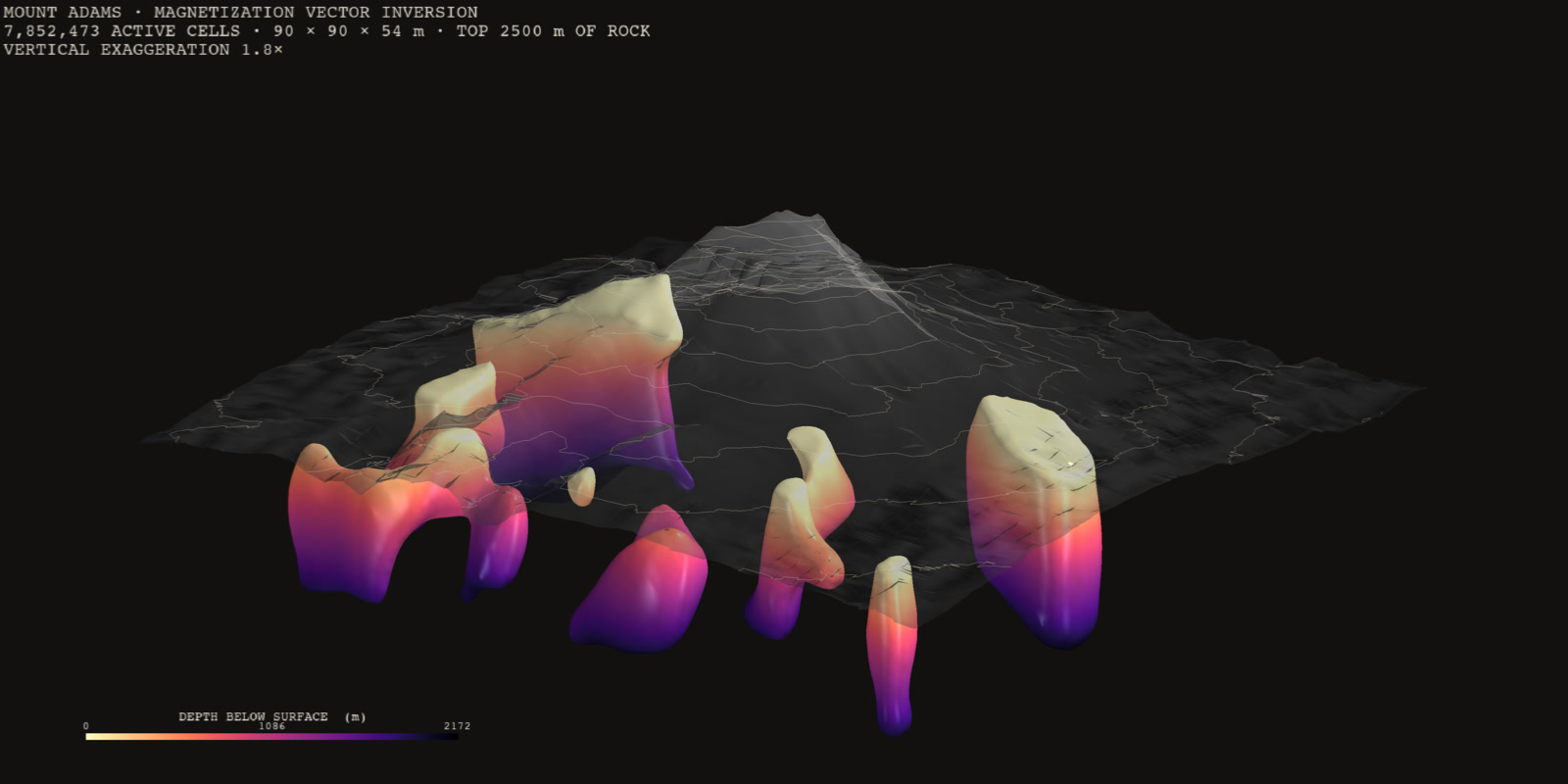
Mount Adams, Washington: 14,007 aeromagnetic stations over a 23 by 24 km block with 2.8 km of relief. The terrain mesh is 11,011,000 cells, 7,852,473 of them active, at 90 × 90 × 54 m. The full-station inversion converged in a combined 2 minutes 54 seconds. Both flight blocks, acquired at different heights, were fitted together.
Capabilities
- Gravity
gx,gy,gz, and the full gradient tensorgxxthroughgzz, from the exact closed-form prism solution.- Magnetics
- Thirteen components: TMI, its three gradients,
bx,by,bz, and the full magnetic gradient tensorbxxthroughbzz. Cross-checked against SimPEG. - Full tensor gradiometry
- Real SQUID gradiometer data, with all six channels inverted together.
- Magnetization vector inversion
- A free vector per cell, on any of those thirteen components. It resolves reversed polarity, which a scalar susceptibility inversion can only absorb as negative susceptibility. It works on TMI near the magnetic equator, without reduction to the pole.
- Meshes
- Built around the survey, with graded padding and cells cut to a digital elevation model.
- Joint survey blocks
- Survey blocks flown at different heights over the same ground can be fitted together on one mesh. Gravity and magnetics can share a terrain mesh.
- Import and export
- In: CSV, and UBC-GIF GRAV3D and MAG3D observation files. Out: mesh and model in UBC-GIF, cell-centre CSV, or NumPy.
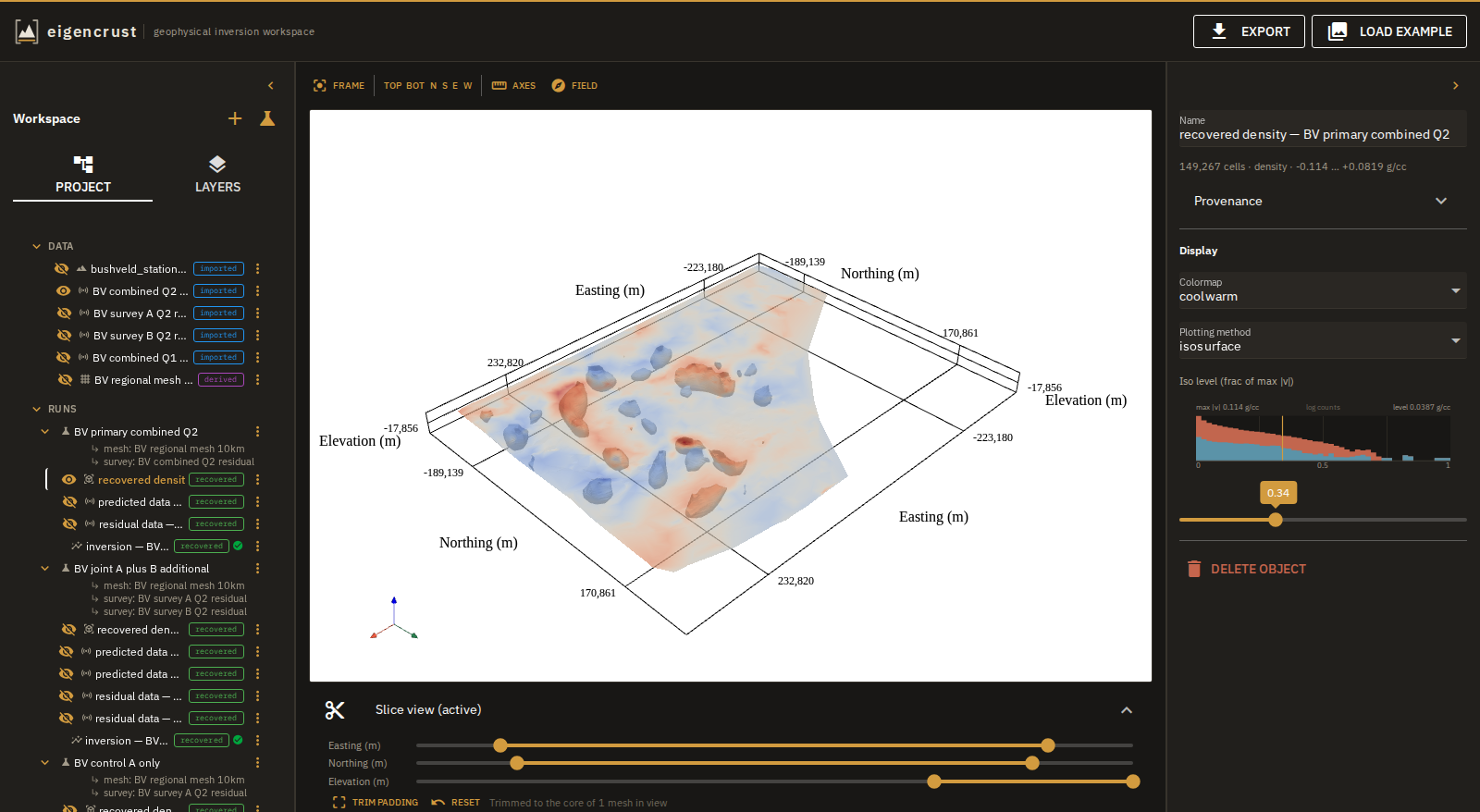
The workspace
Contact
Get in touch to discuss your survey or ask a question.